
Stamped Concrete Pool Decks: A Massachusetts Homeowner's Guide
· By Wesley Martins da Rocha
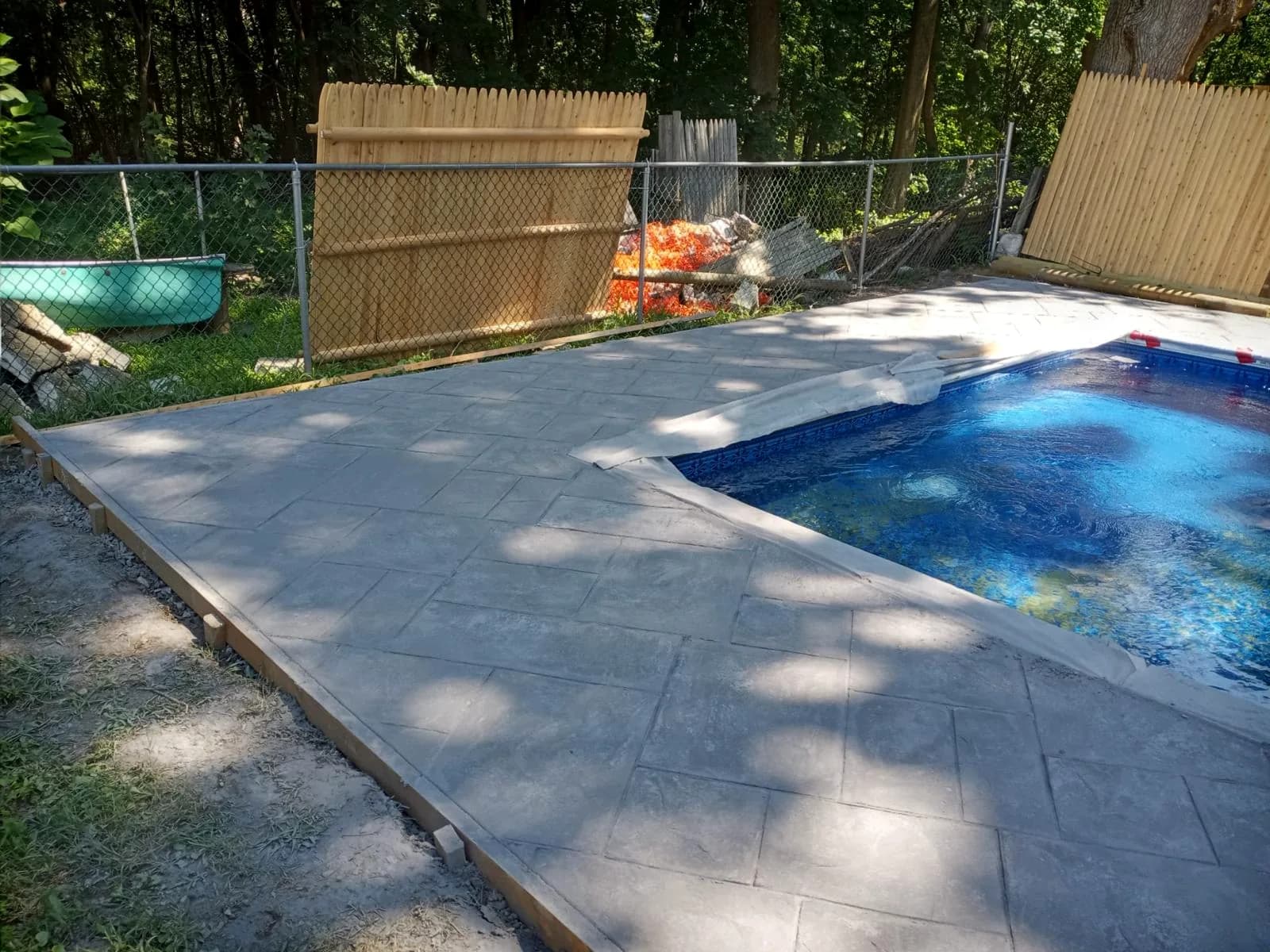
A lot of in-ground pools around Massachusetts still have the original concrete surround they were built with decades ago, and plain concrete around a pool takes a beating. Sun, pool chemicals, and New England's freeze and thaw cycles work on that slab year after year until the surface starts to pit, crack, and heave in spots. At some point patching the same cracks every spring stops making sense, and homeowners start looking at stamped concrete as the replacement.
WR Concrete recently worked on a project like this: an in-ground pool with an old concrete deck that had cracked badly over the years. The whole surround came out and was replaced with a new stamped concrete pool deck, poured fresh around the existing pool shell. This guide covers what goes into a project like that: tearing out the old surround, handling coping and drainage, managing slip resistance and heat, and keeping the deck looking good through a Massachusetts winter.
Why old pool surrounds end up getting replaced
A plain concrete pool deck poured decades ago was built to a different standard than what gets poured today, and it has had a long time to take damage. Pool chemicals splash onto the surface and slowly break it down, sun bakes the slab all summer, and every freeze and thaw cycle pushes more water into existing hairline cracks, widening them bit by bit. Eventually a few small cracks turn into an uneven, chipped surface that is no longer safe to walk on barefoot.
That is the situation WR Concrete ran into on a recent job: an older in-ground pool with a concrete surround that had cracked and settled unevenly over the years. Patching the same spots again was not going to hold up for long, so the decision was to tear out the old surround completely and start over with a new stamped concrete deck poured around the existing pool.
Tearing out the old deck and getting the base right
The old concrete has to come out before anything new goes in: breaking it up and hauling it away without damaging the pool shell or the plumbing around it. Once the old slab is gone, the ground gets graded and compacted into a proper sub-base. Skipping this step and pouring over soft, uneven ground is one of the most common reasons a pool deck cracks and settles again within a few years.
On pour day, a ready-mix truck delivers fresh concrete directly around the pool, usually in sections so the crew can keep up before it sets. Stamping happens while the concrete is still plastic, so the crew works fast, finishing it and pressing texture mats into the surface to create the pattern. That narrow window is why stamped concrete takes an experienced crew, especially tight around a pool edge where the pattern and the coping have to line up cleanly.
Coping and edge detail at the pool's edge
The coping, the strip of concrete forming the actual edge of the pool, is one of the most important details on the whole deck. It needs a clean, slightly rounded edge rather than a sharp lip, since a sharp edge is uncomfortable to sit on and can catch a bare foot. Many pool decks use a different texture or color right at the coping so the edge is visually distinct, which helps swimmers see where the pool starts, especially near steps or a ladder.
Getting the coping right also means thinking about how it meets the water. The edge has to be finished so it does not create a trip hazard, and it has to tie in cleanly with the pool's own structure, whether that is a vinyl liner, gunite shell, or another type. This is detail work that is hard to rush, which is why a cracked old surround like the one on WR Concrete's recent job is usually torn out rather than patched around.
Keeping water moving away from the pool
A pool deck should never be poured dead flat. It needs a slight pitch carrying water away from the coping and toward the lawn, a drain, or another low point, rather than back toward the pool edge or the house. Without that pitch, water pools where people walk barefoot, and standing water next to the coping is exactly what works its way into small cracks over time.
How that drainage gets handled depends on the yard. Some lots just need careful grading away from the pool, while others benefit from a drain or a French drain line to carry water further away. Getting this grading right during the pour is much easier than fixing drainage after the deck is already in.
Slip resistance: texture, sealer, and grit
Stamped concrete already has more texture than a smooth, troweled patio, which helps with grip, but around a pool, where feet are wet and often bare, slip resistance matters even more. A textured stone or slate pattern tends to grip better underfoot than a smoother, more polished-looking finish.
The sealer matters just as much as the pattern. A standard sealer with nothing added can actually make a textured surface feel slick once wet, which is the opposite of what you want next to a pool. For a pool deck, ask specifically for a sealer with a non-slip grit additive mixed in. It adds fine texture to the sealed surface that improves traction without changing the look of the pattern underneath.
Color and pattern choices for a pool deck
Color choice around a pool is not just about looks. Darker stamped concrete colors absorb more heat from direct sun and can get genuinely uncomfortable, sometimes painful, on bare feet in the middle of a July afternoon. Lighter buff, tan, and sandstone tones reflect more sunlight and stay noticeably cooler, which is why they are a common choice for pool surrounds.
Pattern-wise, natural stone looks such as ashlar slate, random stone, or fieldstone tend to suit a pool setting well, since they read as a natural material next to the water. Keeping the color subtle and avoiding heavy, high-contrast staining also helps the deck age well, since a neutral tone shows less wear as the sealer fades and gets renewed over the years.
Resealing, winter care, and pool chemicals
The sealer on a stamped concrete pool deck protects the color, helps with slip resistance, and keeps water and chemicals from soaking in. Around a pool it wears down faster than on a patio away from the water, facing constant sun, splashed chemicals, and more foot traffic. As a rough guide, most pool decks need resealing every couple of years.
Winter care matters just as much in Massachusetts. Freeze and thaw cycles are hardest on concrete with standing water sitting on it, so keeping the deck clear of ice and snowmelt against the coping protects the surface and the sealer. When ice melt is needed, calcium-chloride-based products are a better choice near a sealed pool deck than rock salt, which can be harder on the sealer over repeated winters.
Frequently asked questions
- Is stamped concrete safe to use around a pool?
- Yes, if it is detailed for a pool: a sealer with a non-slip grit additive, a pattern with some texture rather than a smooth finish, and a slight pitch away from the coping so water does not pool underfoot. Those details make the difference between a pool deck that stays safe and one that gets slick when wet.
- How do I keep a stamped concrete pool deck from getting too hot?
- Color choice is the biggest factor. Lighter buff, tan, and sandstone tones reflect more sunlight than dark colors and stay noticeably cooler on bare feet, which is why lighter tones are common on pool surrounds.
- Can stamped concrete be poured right up against an existing pool?
- Yes, as long as the pool shell is sound and the old surround, if there is one, is removed and the base underneath is properly graded and compacted first. The coping needs careful finishing so it ties in cleanly with the pool's own structure.
- How often does a stamped concrete pool deck need to be resealed?
- As a rough guide, every couple of years, though exact timing depends on sun exposure, pool chemical use, and foot traffic. A deck in full sun near a heavily used pool typically needs resealing sooner than a shaded, lightly used one.
- Will pool chemicals damage a stamped concrete deck?
- Chlorine and other pool chemicals splashed onto the surface wear down the sealer faster than normal weather alone, which is why pool decks need more frequent resealing than a patio away from the water. Keeping up with resealing protects the concrete underneath it.
- How do I get a quote for a stamped concrete pool deck in Massachusetts?
- The best way is a free estimate that takes into account the pool, the existing surround if there is one, and the yard's drainage before putting together a plan. Call WR Concrete at (774) 606-6807 or request a free estimate online to get started.
Related services
Found this helpful? Make us a preferred source on Google.
Ready for an exact price?
Get a free, no-pressure in-home estimate. Real numbers for your home, not a phone guess.