
Stamped Concrete in Massachusetts: Cost, Patterns, and How It Holds Up
· By Wesley Martins da Rocha
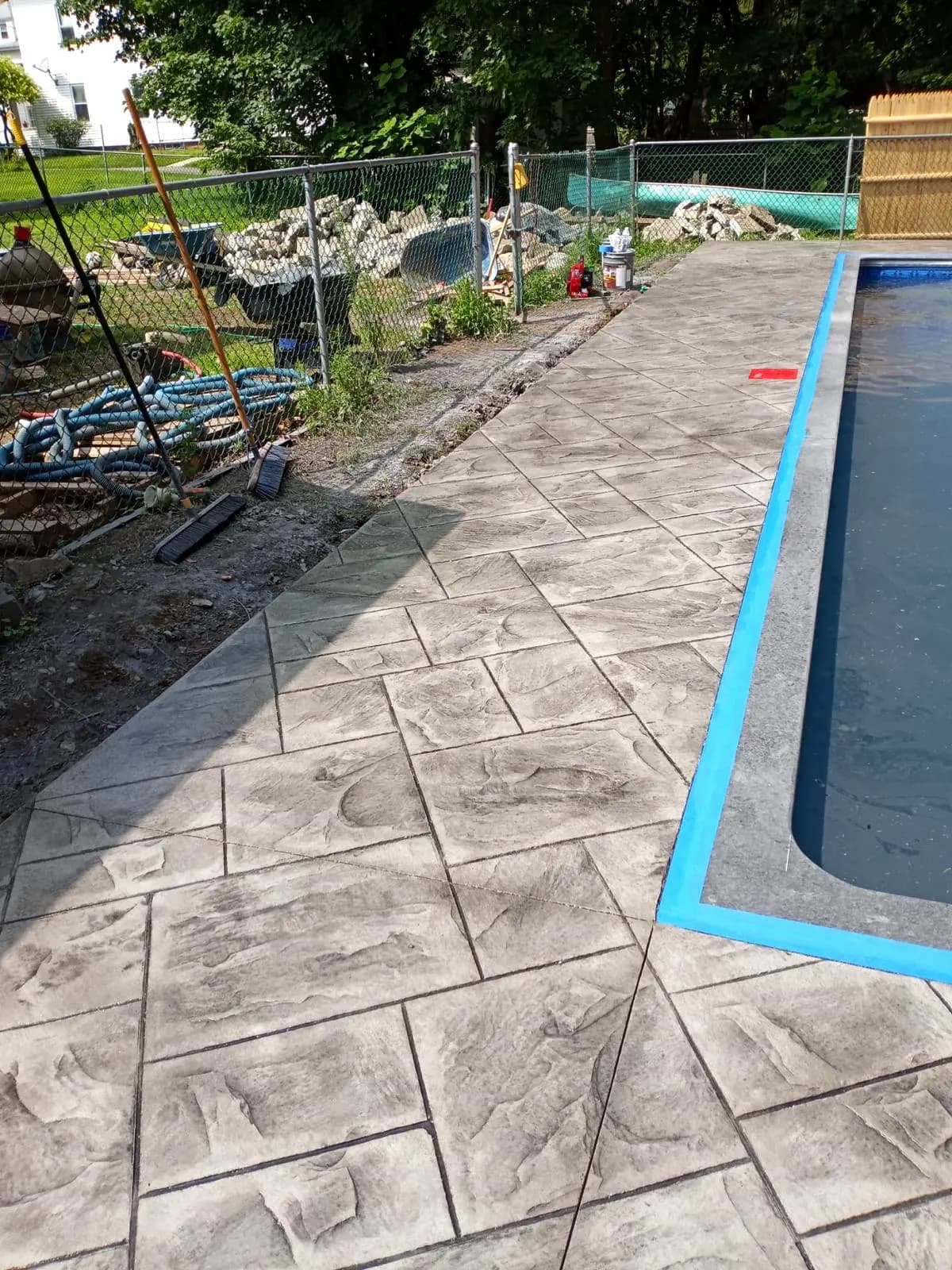
Stamped concrete is one of the few upgrades that changes how a patio, driveway, or pool deck looks without changing what it is underneath: a poured concrete slab. Instead of a flat gray surface, you get the texture of slate, cobblestone, or wood plank at a fraction of what the real materials cost installed.
If you are weighing stamped concrete for a home in Marlborough, Framingham, Hudson, or anywhere else in Massachusetts, the questions are usually the same: what does it cost, which pattern holds up best, and how does it survive a New England winter. This guide covers all three, plus how stamped concrete compares to pavers when you are trying to decide between the two.
What drives stamped concrete pricing
Stamped concrete costs more than plain broom-finished concrete because of the extra labor: color hardener gets worked into the surface while it is still plastic, a release agent keeps the stamp mats from sticking, and the whole pattern has to be stamped, detailed, and cut for joints before the concrete sets up.
As a rough guide, most Massachusetts homeowners see stamped concrete priced noticeably higher per square foot than a plain slab, with the final number moving based on square footage, pattern complexity, number of colors, and how much grading or demo the area needs first. A straightforward rectangular patio prices differently than a pool deck with curves, steps, and a coping detail around the water.
The only way to get a number you can plan around is a free estimate based on the site, the drainage, and what you have in mind.
Popular patterns: slate, ashlar, cobblestone, and wood plank
Slate is one of the most requested patterns because the irregular, fractured-stone look hides minor surface imperfections well and reads as upscale on a patio or front walk. Ashlar slate (a more rectilinear, cut-stone layout) gives a cleaner, more architectural line that pairs well with modern homes.
Cobblestone and Belgian block patterns bring a smaller, repeating unit that works well on driveways and pool borders. Wood plank stamping has grown popular for pool decks specifically: it gives the warmth of a boardwalk look while staying cooler underfoot and far lower maintenance than actual wood decking near water.
There is no single right pattern. It comes down to the style of the house, the size of the area (large open slabs can carry a bigger pattern; smaller walkways often look better with a tighter one), and how the space gets used day to day.
Color hardener and release agent: where the look actually comes from
The base color comes from a color hardener broadcast onto the wet concrete and troweled in, which also adds surface density right where foot traffic and weather hit hardest. A separate release agent, usually a contrasting shade, is dusted on before stamping to keep the textured mats from sticking and to add depth into the low points of the pattern (the grout lines and texture valleys).
That two-tone effect is what makes stamped concrete look like actual stone or wood instead of a flat colored slab. Color choice matters more than people expect going in: lighter bases tend to hide surface dust better over time, while darker bases show more contrast but can read hotter in full sun near a pool.
Sealing and the resealing cycle
Stamped concrete needs a sealer, and that is not a one-time step. The sealer is what protects the color hardener from UV fading, blocks water and deicing salt from getting into the surface, and gives the pattern its characteristic sheen (matte, satin, or glossy, depending on what is chosen).
As a rough guide, most Massachusetts stamped surfaces benefit from resealing every two to three years, sooner for a pool deck or driveway that takes more foot and tire traffic and more direct sun and chlorine exposure. Skipping resealing does not ruin the concrete itself, but it speeds up fading, lets moisture work into hairline cracks, and makes the surface more prone to staining.
A light pressure wash and a fresh coat of sealer is a maintenance task, not a repair. Keeping up with it is the single biggest factor in how good a stamped patio or driveway still looks ten years in.
Freeze-thaw, deicing salt, and surviving a Massachusetts winter
New England winters are hard on any exterior concrete, and stamped surfaces are no exception. The freeze-thaw cycle (water getting into the concrete, freezing, expanding, and thawing repeatedly all winter) is the main driver of cracking and surface scaling over time, which is why air-entrained concrete, a properly compacted base, and control joints matter just as much on a stamped job as on a plain driveway.
Deicing salt is the other factor. Rock salt and some ice-melt products can degrade the sealer faster than on plain concrete, leading to a dull, chalky look if the surface is not resealed. As a rough guide, avoid salt on a brand-new stamped surface through its first winter, and use a concrete-safe, calcium-chloride-based ice melt afterward rather than generic rock salt.
None of this makes stamped concrete a bad fit for Massachusetts. It just means the base prep and winter habits matter more here than in a warmer climate.
Slip resistance around pools and wet areas
A glossy, high-sheen sealer looks great in photos but can get slippery when wet, which matters on a pool deck or anywhere water pools. The fix is usually a slip-resistant additive mixed into the sealer that keeps the texture from turning into a hazard once it is sealed and wet.
Matte and satin sealers also tend to be less slippery than high-gloss finishes, so the sheen level is worth discussing up front for any area near a pool, a hot tub, or that gets hosed down often.
Stamped concrete vs. pavers: which fits your project
Stamped concrete and pavers both deliver a decorative, upscale look, but they behave differently over time. Pavers are individual units, so if one cracks or settles it can usually be popped out and replaced without disturbing the rest. Stamped concrete is a monolithic slab, so a crack in one spot is part of the whole surface, though well-placed control joints are designed to catch most movement in a way that is barely noticeable.
Stamped concrete has no joints for weeds or ants to work into and stays flatter underfoot for furniture and pool equipment. Pavers can shift slightly over the years as the base settles, which stamped concrete generally does not do when the base prep is right.
The two often land closer in cost than people assume. The real question is maintenance style: pavers mean periodic joint sand and unit swaps, stamped concrete means a resealing cycle. Neither is wrong, it comes down to which upkeep rhythm fits the household.
Frequently asked questions
- How much does stamped concrete typically cost in Massachusetts?
- It varies by square footage, pattern complexity, number of colors, and site conditions, so there is no single number that fits every job. As a rough guide, stamped concrete runs noticeably higher per square foot than plain concrete because of the extra labor and materials involved. A free estimate is the only reliable way to get a price for a specific patio, driveway, or pool deck.
- Does stamped concrete crack in Massachusetts winters?
- Any concrete can crack over time, and freeze-thaw cycles are the main driver in this climate. Properly placed control joints, air-entrained concrete, and a well-compacted base all reduce the risk significantly. A crack along a control joint is expected and usually barely visible; the goal of good installation is to control where movement happens rather than prevent it entirely.
- How often does stamped concrete need to be resealed?
- As a rough guide, most stamped surfaces in Massachusetts benefit from resealing every two to three years. Areas with heavier traffic, direct sun, or pool chemical exposure may need it sooner. Resealing protects the color and the surface from water and deicing salt intrusion.
- Is stamped concrete slippery around a pool?
- It can be if a high-gloss sealer is used without a slip-resistant additive. Most pool decks use a matte or satin sealer with a grit additive mixed in specifically to keep the surface safe when wet. This is worth asking about before the sealer goes down, not after.
- Can I put salt on a new stamped concrete driveway?
- It is best to avoid rock salt and most deicing products on stamped concrete through its first winter while the concrete and sealer fully cure. After that, a concrete-safe, calcium-chloride-based ice melt is generally a safer choice than generic rock salt, which can be harder on the sealer over time.
- Is stamped concrete better than pavers for a Massachusetts patio?
- Neither is strictly better. Pavers allow individual unit replacement and flex slightly with ground movement; stamped concrete has no joints for weeds and stays flatter underfoot but moves as one slab. The right choice usually comes down to the maintenance style you would rather deal with over the years.
Related services
Found this helpful? Make us a preferred source on Google.
Ready for an exact price?
Get a free, no-pressure in-home estimate. Real numbers for your home, not a phone guess.