
How to Care for New Concrete Through Its First Massachusetts Winter
· By Wesley Martins da Rocha
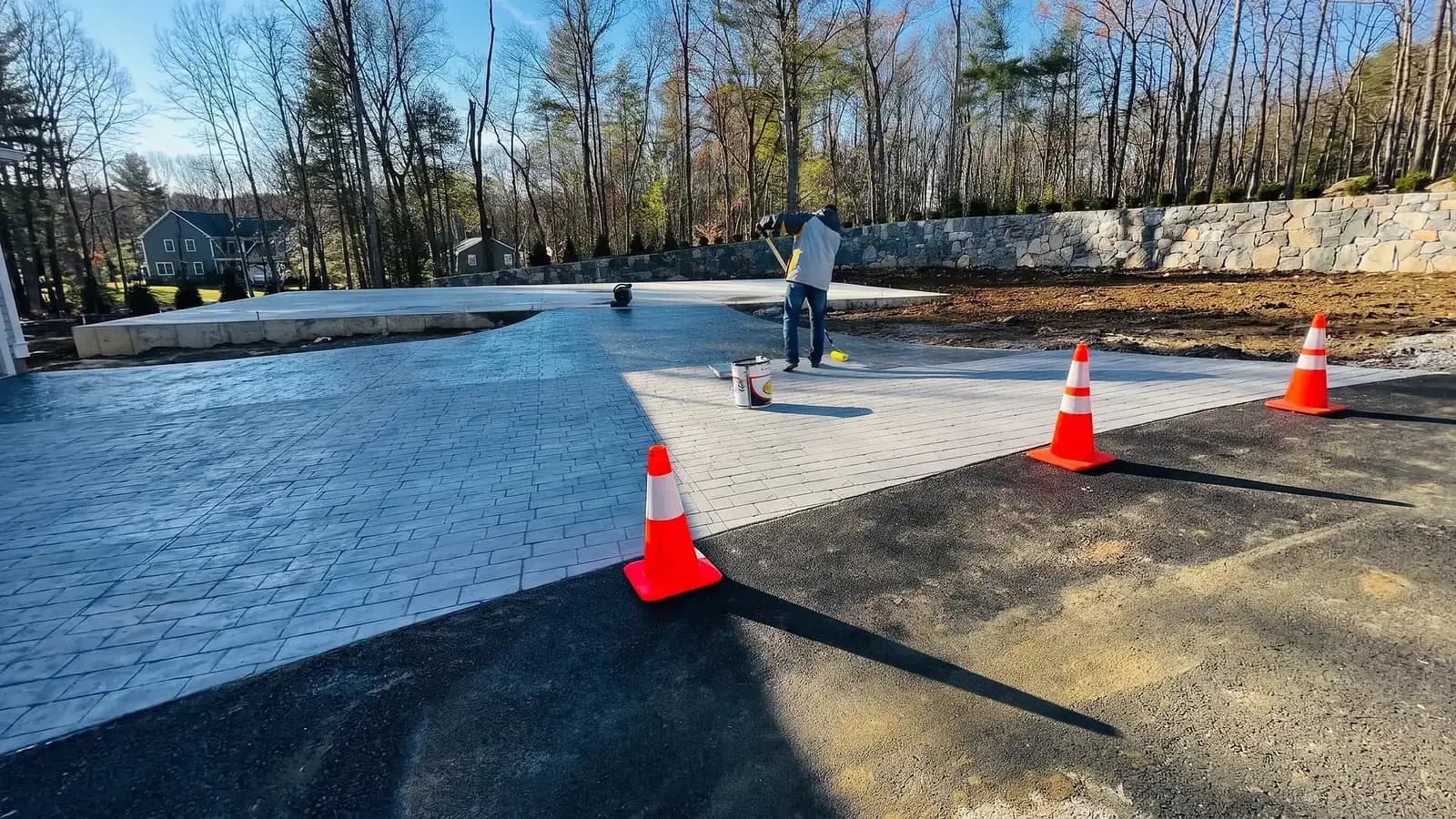
A new concrete driveway, walkway, or patio looks finished the day it is poured, but the concrete is still changing underneath that smooth surface for weeks afterward. If that first winter hits before the slab has fully settled in, a few bad habits (the wrong deicer, a metal shovel blade, water pooling against the edge) can leave marks that stick around for years.
None of this is complicated once you know the timeline. This guide covers how long new concrete actually needs to cure, when it is safe to seal, which deicing products to avoid, and how to handle plowing, shoveling, and drainage so a new pour comes through its first New England winter looking the way it should.
How long new concrete needs before you use it
Concrete does not reach its working strength the moment the finishing crew leaves. As a general guide, new concrete is typically safe to walk on within 24 to 48 hours, once the surface has firmed up enough to hold weight without marking. Driving a car onto it is a different question: most new slabs and driveways need about 7 days before they can handle vehicle weight, and even then the concrete is still gaining strength underneath.
Full design strength usually is not reached until around 28 days after the pour, which is the number most engineers and ready-mix plants use as the benchmark. That does not mean the slab is fragile for a month, but it does mean a new driveway poured in late fall is still in its early strength-gain window right as the first hard freezes show up, which is exactly why the first winter needs a bit more attention than the ones that follow.
When to seal new concrete, and how often to reseal
Sealing protects concrete from water, salt, and freeze-thaw damage, but sealing too early traps moisture that is still working its way out of the slab. As a rough guide, most new concrete should cure for roughly 28 to 30 days before the first sealer goes on, which often pushes a late-fall pour's first sealing into early winter or, in some cases, into spring if the weather will not cooperate.
After that first coat, a standard broom-finished driveway or walkway typically gets resealed every 2 to 3 years in a Massachusetts climate, while a stamped or decorative surface usually needs it a bit more often, often every 1 to 2 years, because the texture and color are more exposed to UV and salt exposure. A free estimate from WR Concrete can confirm the right sealer type and timing for a specific pour.
Deicing salt: what to avoid the first winter
Rock salt (sodium chloride) is cheap and effective, but it is hard on new concrete. It works by lowering the freezing point of water on the surface, which creates more freeze-thaw cycling right at the top of the slab, exactly where new concrete is most vulnerable before it has fully cured and been sealed. Repeated use over that first season is one of the most common reasons homeowners see surface flaking, known as scaling, on a new driveway or walkway.
For the first winter, plain sand gives you traction without any chemical exposure. If ice removal is necessary, calcium magnesium acetate (CMA) or a deicer specifically labeled safe for new or decorative concrete is a better choice than rock salt or calcium chloride, both of which are harder on an unsealed or newly sealed surface. Reading the bag before you buy it is worth the extra minute.
Plowing and shoveling without scarring the surface
A metal plow blade or a metal shovel edge dragged across new concrete can gouge or scratch a surface that has not fully hardened, and on a stamped or textured driveway it can chip the high points of the pattern. A plastic or rubber-edged shovel, and a plow set with a poly or rubber edge guard, both remove snow just as well without biting into the concrete underneath.
It also helps to set the plow blade slightly higher than usual for that first season rather than scraping tight to the surface, and to clear snow a little more often in smaller passes rather than letting it pack down into ice that then needs more aggressive scraping or more deicer to break up.
Drainage and downspouts: keep water moving away from the slab
Water that sits against the edge of a new slab, or that runs across it repeatedly from a nearby downspout, is one of the bigger long-term threats to concrete in a freeze-thaw climate. Water gets into any small opening, freezes, expands, and widens the opening a little more every cycle, all winter long.
Before the ground freezes, walk the perimeter of any new driveway, walkway, or patio and check that downspouts discharge away from the slab, and that grading next to the concrete slopes away from it. A small fix to a downspout extension or a bit of regrading in the fall beats dealing with standing water and ice all winter.
Hairline cracks at the control joints are normal
Control joints (the straight grooved lines cut or formed into a slab) are built in on purpose. Concrete shrinks slightly as it cures and contracts and expands with temperature, and those joints give it a place to crack in a straight, planned line instead of cracking randomly across the surface. Seeing a thin hairline crack appear right along a control joint, especially after the first winter's freeze-thaw cycles, is expected behavior, not a sign of a failed pour.
What is worth watching for is a crack that runs away from the joint at an angle, one that is wide enough to catch a fingernail, or one where one side of the crack sits higher than the other. Those patterns point to something underneath the slab, like a base or drainage issue, rather than normal shrinkage, and are worth a second look.
Extra care for a new stamped concrete surface
Stamped concrete carries its texture and color coat right at the surface, which means it feels the effects of its first winter more than a plain broom-finished slab does. The sealer on a stamped pool deck, patio, or driveway is doing real work: it is what keeps salt, water, and UV exposure from fading the color or lifting the texture over time, so staying on top of the resealing interval matters more here than on any other type of concrete surface.
Beyond sealing, the same rules apply with a bit less margin for error: skip rock salt, use a plastic shovel or plow edge, and keep water from pooling in the low points of the pattern. A stamped surface that gets this kind of care through its first winter tends to hold its color and texture well for years afterward.
Frequently asked questions
- How soon can I drive on new concrete?
- As a general guide, new concrete is typically safe to walk on within 24 to 48 hours and ready for regular vehicle weight after about 7 days, though it keeps gaining strength for roughly 28 days total. Heavier vehicles, like a moving truck, should wait longer than a standard car.
- How long should I wait before sealing new concrete?
- Most new concrete needs about 28 to 30 days of curing before the first sealer coat goes on. Sealing too early can trap moisture still working its way out of the slab, which causes more problems than it solves.
- Is rock salt bad for new concrete?
- Yes, especially in the first winter. Rock salt increases freeze-thaw cycling right at the surface of concrete that has not fully cured or been sealed yet, which is one of the most common causes of surface scaling. Plain sand or a deicer labeled safe for new or decorative concrete is a better choice for that first season.
- Why are there small cracks along the lines in my new concrete?
- Those lines are control joints, built in on purpose so the slab cracks in a straight, planned place instead of randomly. A thin hairline crack right along a control joint, particularly after the first winter, is normal. A crack that runs off at an angle or where one side sits higher than the other is worth having looked at.
- Can I plow a new concrete driveway its first winter?
- Yes, but use a plow with a plastic or rubber edge guard rather than bare metal, and set the blade a little higher than you normally would. A metal edge dragged across new or stamped concrete can scratch or chip the surface before it has fully hardened.
- How often does stamped concrete need to be resealed in Massachusetts?
- As a rough guide, stamped and decorative concrete typically needs resealing every 1 to 2 years in a Massachusetts climate, more often than a plain broom-finished surface, because the color and texture coat are more exposed to salt, water, and UV. A free estimate can confirm the right resealing interval for a specific surface.
Related services
Found this helpful? Make us a preferred source on Google.
Ready for an exact price?
Get a free, no-pressure in-home estimate. Real numbers for your home, not a phone guess.