
How Much Does a Concrete Driveway Cost in Massachusetts? (2026 Guide)
· By Wesley Martins da Rocha
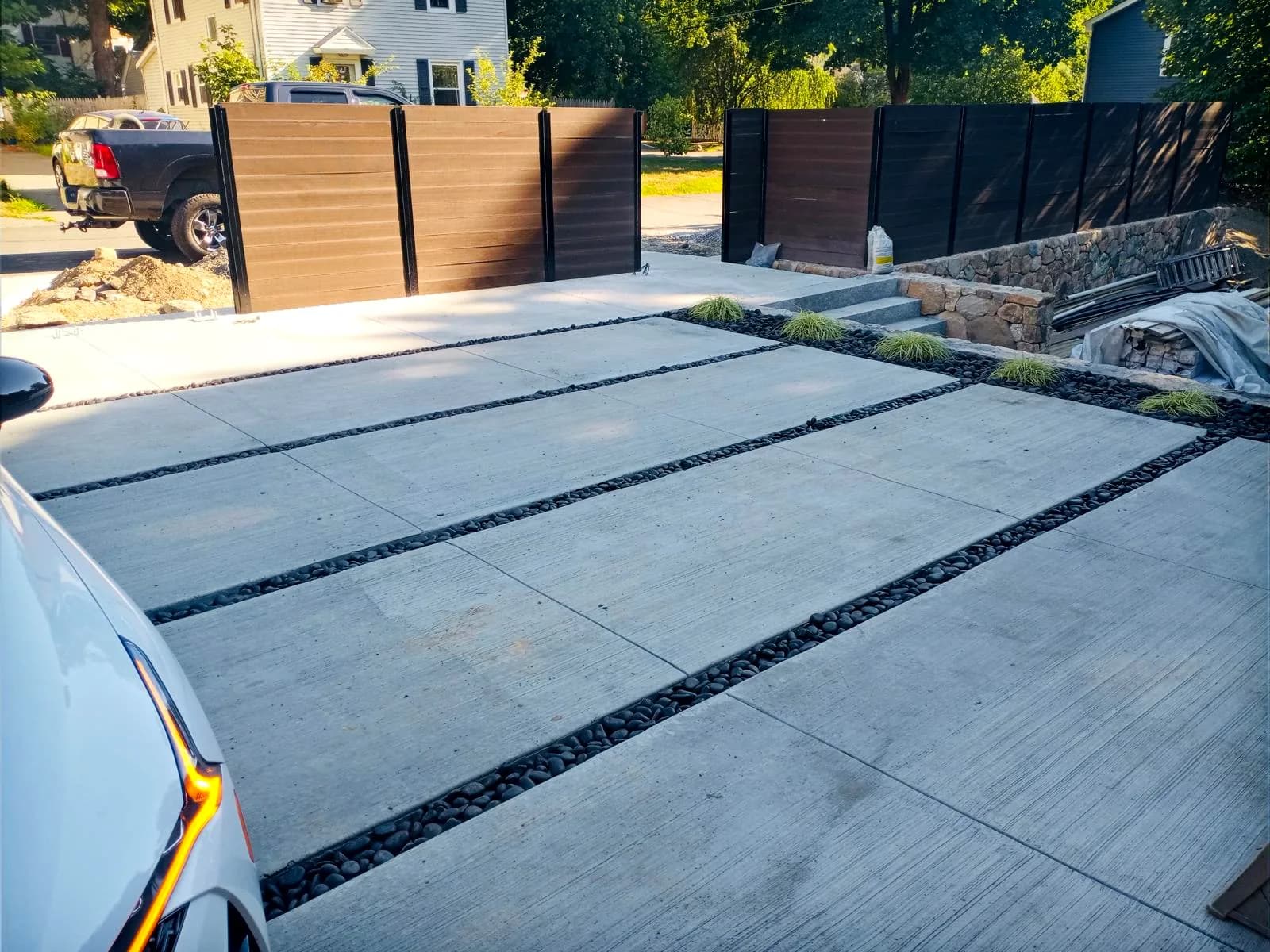
A new concrete driveway is one of the bigger exterior projects a Massachusetts homeowner can take on, and the cost swings more than most people expect. Two driveways that look almost identical from the street can be priced very differently once you factor in thickness, base preparation, what has to be removed first, and the finish on top.
This guide breaks down what typically drives the price of a concrete driveway in Massachusetts in 2026: size and thickness, base prep, removing old asphalt or concrete, reinforcement, finish choices like broom, exposed aggregate, or stamped concrete, and the apron where the driveway meets the street. It also covers why Massachusetts winters change the math. None of the numbers below are a quote, they are market-typical ranges to help you ask the right questions once you get a free estimate.
Typical Cost Ranges for a Concrete Driveway in 2026
As a rough guide, most homeowners in Massachusetts see concrete driveway pricing land somewhere between $8 and $18 per square foot installed, with a plain broom finish on the lower end and decorative finishes like stamped or exposed aggregate pushing toward the higher end. A single-car driveway usually comes in smaller overall, while a long double-wide driveway built to park two or three vehicles adds square footage fast.
These ranges move with site conditions as much as size. A flat lot with easy truck access costs less to finish than a sloped driveway, a tight lot, or a long run that needs a pump truck to reach the pour. The only way to get a number you can rely on is a free estimate based on the actual site, the grade, and how the driveway ties into the garage and the street.
What's Under the Slab Matters More Than the Slab Itself
A concrete driveway is only as good as the base underneath it. Before any concrete gets poured, the old surface, whether that is cracked concrete or asphalt, typically needs to come out, and the subgrade needs to be excavated to the right depth and compacted in layers. WR Concrete treats this step as the one that decides whether a driveway lasts, since rushing it is one of the most common reasons a driveway cracks or settles unevenly within a few years.
Removing old asphalt or concrete adds cost, both in labor and in disposal, and that cost usually depends on the thickness, how much material there is, and how it needs to be hauled away. A properly compacted gravel base, typically 4 to 6 inches of crushed stone, gives the new slab something solid to sit on and helps water drain away instead of pooling underneath, which matters a lot once winter freeze and thaw cycles start.
Reinforcement: Rebar, Wire Mesh, or Fiber
Reinforcement helps control cracking as concrete cures and as the ground shifts slightly underneath it over the years. Options typically include steel rebar laid on a grid, welded wire mesh, or fiber mesh mixed directly into the concrete, and each adds a different amount to the overall cost.
None of these stop cracking entirely, since concrete will develop some hairline cracks over time no matter what. The right reinforcement, combined with properly placed control joints, keeps cracks tight and predictable instead of wide and uneven. This is worth asking about when comparing estimates, since cutting reinforcement to save money upfront often costs more in repairs later.
Finish Options and How They Change the Price
Broom finish is the standard, most affordable option, and it gives the surface enough texture for traction, which matters in a Massachusetts winter. Exposed aggregate, where the top layer is washed or ground back to reveal the stone inside the mix, costs more because of the extra labor, and it typically gives a driveway more visual texture.
Stamped concrete goes a step further, pressing a pattern like cobblestone, slate, or brick into the surface before it cures, then usually sealing it for color and protection. Stamped driveways, aprons, and even a stamped border around a plain broom finish field are common ways homeowners get a decorative look without stamping the entire surface, which helps manage cost while still improving curb appeal.
The Apron and Curb: Small Area, Real Cost
The apron is the section of concrete where the driveway meets the street or sidewalk, and it often gets overlooked in early cost conversations. This area takes more wear from turning tires and, depending on the town, may need to match a specific curb cut or drainage detail.
Permit requirements for driveway and apron work vary by town, and your local building department sets them, so it is worth checking before work starts, especially if the driveway touches a public sidewalk or street. A free estimate is a good time to raise this, since it affects both the design and the timing of the pour.
Why Massachusetts Freeze-Thaw Cycles Matter
Massachusetts winters put concrete through repeated freezing and thawing, and that cycle is hard on a driveway that was not built for it. Air-entrained concrete, which has tiny air bubbles mixed in on purpose, gives water room to expand without cracking the slab, and it is a standard spec for exterior concrete in this climate.
Control joints cut into the surface at regular intervals give the concrete planned places to crack instead of cracking randomly, and a sealant applied after curing helps block water and de-icing salt from soaking in. Many driveway problems in Massachusetts trace back to skipping one of these steps, particularly in that first winter before the concrete has fully matured.
Concrete vs Asphalt: Which Makes Sense for Your Driveway
Asphalt typically costs less upfront than concrete, and it can be a reasonable choice for a straightforward driveway on a tighter budget. Concrete usually costs more to install but tends to last longer and holds up well against oil stains and heavy vehicles without softening in summer heat the way asphalt can.
Concrete also opens the door to finish options like stamped patterns and exposed aggregate that asphalt cannot match, which is part of why many homeowners upgrading from an old asphalt driveway choose concrete this time around. The right answer depends on budget, how long you plan to stay in the home, and how much the look of the driveway matters to you. Call WR Concrete at (774) 606-6807 or request a free estimate online to get pricing based on your actual driveway, not a general range.
Frequently asked questions
- How thick should a concrete driveway be in Massachusetts?
- For a standard passenger driveway, 4 inches of concrete over a well-compacted gravel base is typical. If the driveway needs to handle heavier vehicles, like a work truck or RV, going to 5 or 6 inches with added reinforcement is the usual recommendation. A free estimate is the best way to confirm the right thickness for your specific use.
- Is it cheaper to pour a new driveway over old asphalt?
- Pouring directly over asphalt is rarely a good shortcut. Asphalt shifts and breaks down differently than concrete, so it usually needs to be removed and the base rebuilt properly underneath. Skipping removal might save money upfront but tends to show up later as cracking or an uneven surface.
- How long before I can drive on a new concrete driveway?
- Concrete is typically firm enough to walk on within 24 to 48 hours, but it usually needs about 7 days before it is ready for regular vehicle traffic. Full strength develops over roughly 28 days, which is also when it is safest to apply sealant or deal with de-icing products.
- How much more does stamped concrete cost compared to plain concrete?
- Stamped concrete typically costs more than a plain broom finish because of the extra labor for stamping, coloring, and sealing. Many homeowners manage the cost by stamping just the apron or a border and keeping the main field of the driveway in a standard broom finish.
- What can I do to protect a new driveway through its first Massachusetts winter?
- Avoid using rock salt or other de-icing chemicals on brand-new concrete during its first winter, since the surface is still maturing and is more vulnerable to scaling. A calcium-chloride-free ice melt or sand for traction is a safer choice early on, and a quality sealant applied once the concrete has cured helps protect it for winters after that.
- Who is responsible for the driveway apron where it meets the street?
- That depends on the town. Some aprons sit partly on town-owned right-of-way, which can mean specific requirements for the cut, slope, or drainage. Permit requirements vary by town and your local building department sets them, so it is worth checking early, ideally when you get your free estimate.
Related services
Found this helpful? Make us a preferred source on Google.
Ready for an exact price?
Get a free, no-pressure in-home estimate. Real numbers for your home, not a phone guess.